
No products in the cart.
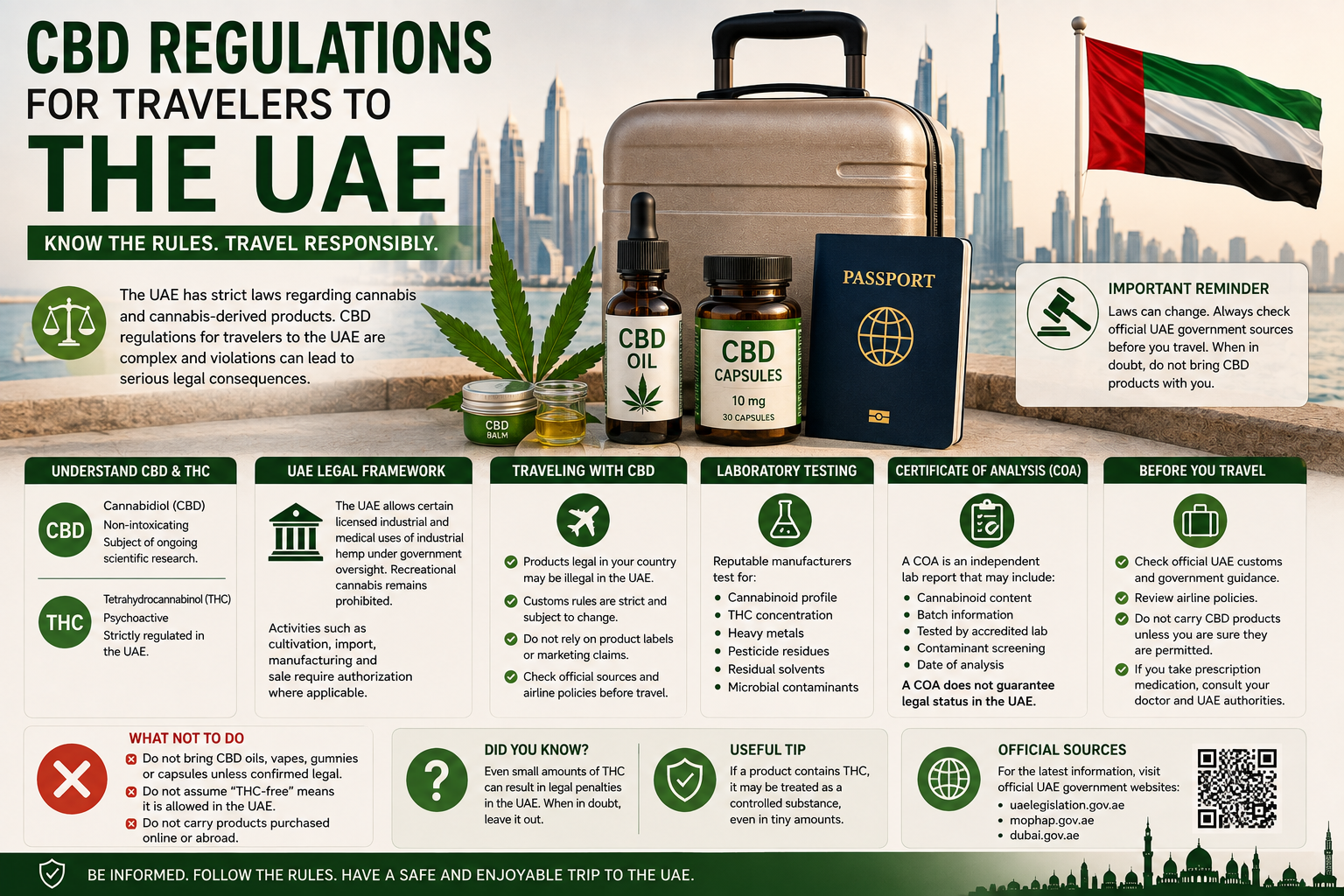
CBD regulations for travelers to the UAE
CBD Regulations for Travelers to the UAE: A Complete Guide to Understanding the Rules
Travelers frequently search for information about CBD regulations for travelers to the UAE before visiting Dubai, Abu Dhabi, Sharjah, and the other emirates. Cannabis and hemp laws differ significantly around the world, and products that are legal in one country may be prohibited or tightly regulated in another.
Understanding the applicable rules before traveling can help visitors avoid unnecessary legal complications. This guide explains the basics of cannabidiol (CBD), how it differs from tetrahydrocannabinol (THC), the UAE’s approach to cannabis regulation, and practical considerations for international travelers.

Why Travelers Should Understand UAE Regulations
Every country has its own drug-control laws. While some jurisdictions allow consumer CBD products, others regulate or prohibit them.
The UAE has strict laws governing controlled substances and many cannabis-derived products. Travelers should not assume that products purchased legally elsewhere can automatically be brought into the UAE.
Before traveling, always review the latest guidance from UAE authorities and your airline regarding restricted goods.
What Is CBD?
Cannabidiol (CBD) is one of more than one hundred naturally occurring cannabinoids found in the Cannabis sativa plant.
Unlike tetrahydrocannabinol (THC), CBD is not considered intoxicating. Researchers continue to study CBD in laboratory and clinical settings, but laws governing CBD products vary widely between countries.
CBD vs THC
Understanding the distinction between CBD and THC is important.
CBD (Cannabidiol)
- Non-intoxicating cannabinoid
- Subject of ongoing scientific research
- Legal status varies by jurisdiction

THC (Tetrahydrocannabinol)
- Primary psychoactive cannabinoid
- Produces intoxicating effects
- Usually subject to stricter legal controls
Even products marketed as “CBD” may contain trace amounts of THC depending on how they are manufactured. This is one reason travelers should verify both the product’s composition and the laws of their destination.
Industrial Hemp
Industrial hemp is generally cultivated under legal THC limits for approved industrial, scientific, or certain medical purposes.
Common industrial uses include:
- Textile production
- Paper manufacturing
- Construction materials
- Sustainable packaging
- Agricultural research
- Industrial fibers
Industrial hemp regulations differ from those governing higher-THC cannabis.
UAE Regulatory Framework
The UAE has introduced a framework allowing certain licensed industrial and medical uses of industrial hemp under government oversight. These provisions do not create a general consumer market for cannabis or hemp-derived products.
Activities involving cultivation, manufacturing, import, export, or scientific use require authorization where applicable. Recreational cannabis remains prohibited under UAE law.
Because regulations may evolve, travelers should rely on official UAE government sources for current requirements.
Traveling with CBD Products
If you are considering traveling to the UAE, it is important to remember that:
- Products that are legal in your home country may not be permitted in the UAE.
- Product labels alone may not accurately describe cannabinoid content.
- Customs and regulatory requirements can change over time.
Before packing any hemp- or cannabis-derived product, verify the current rules through official sources.
Understanding Product Labels
Consumers often encounter terms such as:
- Hemp seed oil
- CBD oil
- Broad-spectrum hemp extract
- Full-spectrum hemp extract
- CBD isolate
These descriptions do not necessarily indicate whether a product is permitted in a particular jurisdiction. Product terminology varies, and regulatory treatment depends on applicable law.
Why Laboratory Testing Matters
Where hemp-derived products are legally manufactured, independent laboratory testing commonly evaluates:
- Cannabinoid profile
- THC concentration
- Heavy metals
- Pesticide residues
- Residual solvents
- Microbiological contaminants
Many manufacturers also provide a Certificate of Analysis (COA), which documents laboratory findings for a specific production batch.
Certificate of Analysis (COA)
A COA is an independent laboratory report that may include information such as:
- Cannabinoid concentrations
- Batch identification
- Testing laboratory
- Contaminant screening
- Date of analysis
While a COA can help describe a product’s composition, it does not determine whether a product is lawful to carry into another country.
Scientific Research
Researchers continue studying cannabinoids in several fields, including:
- Cannabinoid chemistry
- Plant genetics
- Pharmaceutical sciences
- Agricultural science
- Analytical laboratory testing
- Endocannabinoid system biology
Scientific knowledge continues to develop, and regulatory approaches may change as new evidence emerges.
Practical Travel Tips
Before traveling to the UAE:
- Check official UAE customs and government guidance.
- Review your airline’s policies on restricted items.
- Do not rely solely on information from retailers or social media.
- Be aware that laws may change over time.
- If you have questions about prescribed medicines, consult your healthcare provider and the relevant UAE authorities before travel.
Frequently Asked Questions
Is CBD treated the same way in every country?
No. Laws vary considerably between jurisdictions, so travelers should always check the rules for their destination.
What is the difference between hemp seed oil and CBD oil?
Hemp seed oil is pressed from hemp seeds and contains little to no cannabinoids. CBD oil is formulated using cannabidiol extracted from cannabinoid-rich parts of the hemp plant and combined with a carrier oil.
Does a Certificate of Analysis make a product legal?
No. A COA provides laboratory information about a product but does not determine whether it may legally be imported, possessed, or used in a particular country.
Why is it important to review official guidance before traveling?
Government regulations can change, and official sources provide the most reliable information about customs requirements and restricted goods.
Conclusion
Understanding CBD regulations for travelers to the UAE is an important part of travel planning. Because cannabis- and hemp-related laws differ around the world, visitors should avoid assuming that products legal in one country are automatically permitted in another.
Checking official UAE guidance before departure, understanding the difference between CBD and THC, reviewing product information carefully, and staying informed about current regulations can help travelers prepare responsibly and reduce the risk of legal issues during their visit.