
No products in the cart.
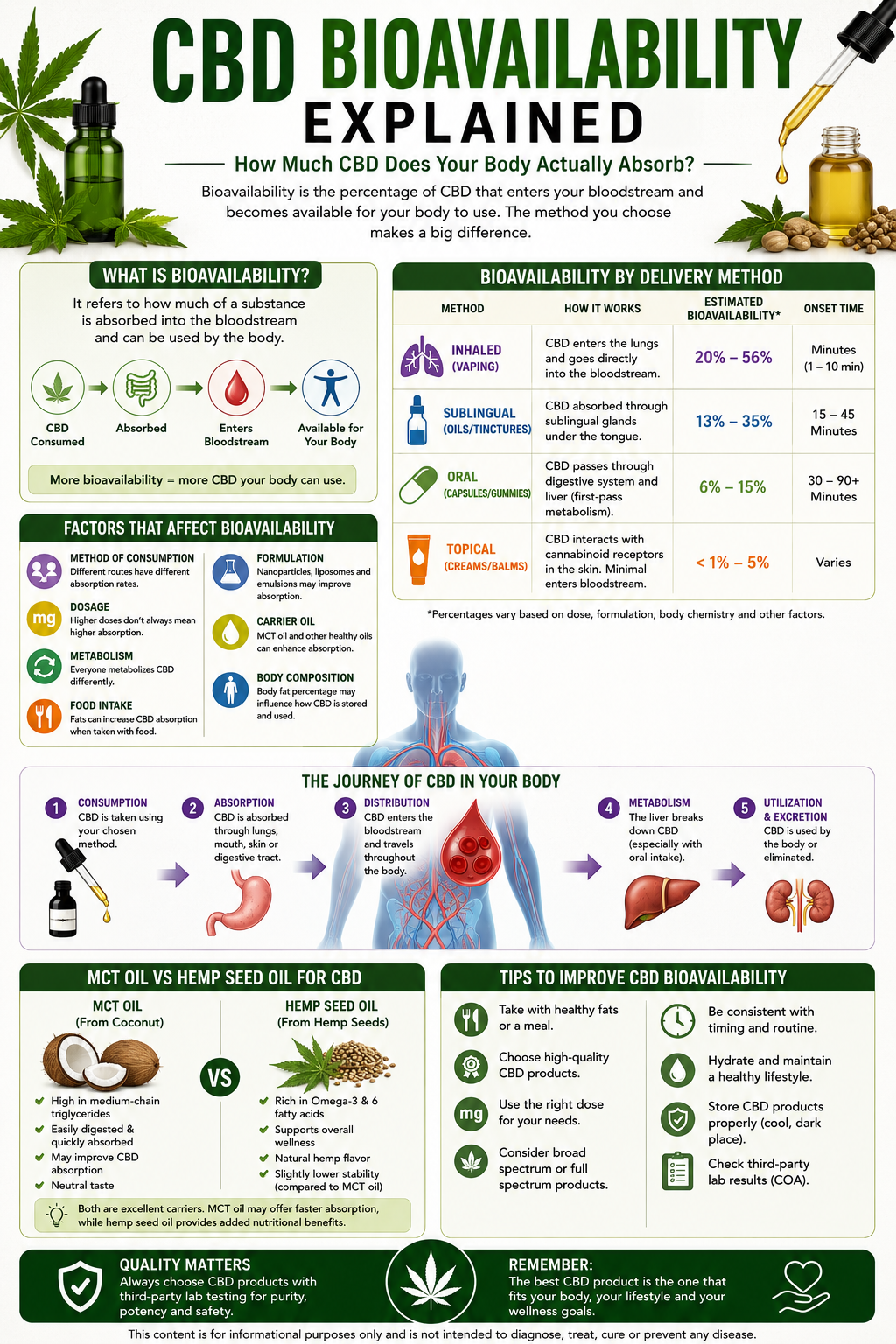
CBD Bioavailability Explained
CBD Bioavailability Explained: A Complete Guide to CBD Absorption
CBD Bioavailability Explained, CBD products are available in many different forms, including oils, capsules, gummies, beverages, topical formulations, and other delivery systems. Although two products may contain the same labeled amount of cannabidiol, they may not behave identically after use. One major reason is bioavailability.
Understanding CBD Bioavailability Explained means examining how much CBD becomes available to the body after administration, how quickly it reaches circulation, and which factors may influence absorption. The route of administration, product formulation, food intake, metabolism, individual physiology, and manufacturing technology can all affect the way CBD is processed.
Bioavailability is often discussed in CBD marketing, but the topic is more complex than claims such as “maximum absorption” or “fast acting.” This complete guide explains what CBD bioavailability means, how different delivery methods compare, which factors influence absorption, and why consumers should approach exaggerated percentage claims carefully.
What Is CBD Bioavailability?
Bioavailability is a pharmacokinetic concept describing the proportion of an administered substance that reaches systemic circulation in an available form.
When a substance is administered directly into the bloodstream, its bioavailability is considered complete by definition. However, most consumer CBD products are not administered intravenously. Instead, they may be:
- Swallowed
- Held in the mouth
- Inhaled
- Applied to the skin
- Incorporated into specialized delivery systems
Each route creates different barriers and processing pathways.
In simple terms, CBD Bioavailability Explained can be summarized as:
How much of the administered CBD becomes systemically available, and how does it get there?
This is different from simply asking how many milligrams are printed on the product label.
Why CBD Bioavailability Matters
Suppose two products each contain a labeled serving of 25 mg CBD.
Product A is a capsule.
Product B is an oil-based formulation.
Even though both labels state 25 mg, factors such as digestion, formulation, administration technique, food intake, and individual metabolism may influence exposure.
Bioavailability matters because it can affect:
- Systemic exposure
- Time to measurable concentrations
- Peak concentration
- Duration of exposure
- Product-to-product variability
- Interpretation of research findings
However, higher bioavailability does not automatically mean a product is “better.” The appropriate formulation depends on intended use, route, convenience, consistency, and individual circumstances.
Understanding Absorption, Bioavailability, and Bioaccessibility
These terms are sometimes confused.
Absorption
Absorption refers to the movement of a substance from the administration site into the body.
Bioavailability
Bioavailability refers to the proportion of an administered dose that reaches systemic circulation in an available form.
Bioaccessibility
Bioaccessibility is often used to describe the fraction of a compound released from a formulation or food matrix and made available for potential absorption.
These concepts overlap but are not identical.
A product may release CBD effectively from its formulation while still facing biological barriers before reaching systemic circulation.
Why CBD Can Be Difficult to Absorb
CBD is highly lipophilic, meaning it has a strong affinity for fats and oils and relatively poor water solubility.
This creates formulation challenges because the human gastrointestinal environment contains significant aqueous components.
CBD absorption can be influenced by:
- Dissolution
- Digestion
- Bile secretion
- Lipid processing
- Intestinal transport
- Metabolism
- Formulation design
This is one reason many CBD products use carrier oils such as:
- MCT oil
- Hemp seed oil
- Olive oil
- Other lipid-based carriers
The carrier oil is not merely decorative. It can be an important part of the formulation system.
What Is First-Pass Metabolism?
First-pass metabolism is essential to understanding CBD Bioavailability Explained.
When CBD is swallowed, it passes through the gastrointestinal system. After absorption from the intestine, compounds may travel through the portal circulation to the liver before reaching broader systemic circulation.
During this process, metabolism can reduce the amount of unchanged compound reaching circulation.
This is known as first-pass metabolism.
The extent of metabolism can vary depending on:
- Dose
- Formulation
- Food intake
- Enzyme activity
- Individual physiology
- Other substances being used
This helps explain why swallowed products may behave differently from routes that partially bypass gastrointestinal processing.
Oral CBD Bioavailability
Oral CBD products are swallowed and processed through the digestive system.
Examples include:
Oral administration is popular because it is:
- Convenient
- Familiar
- Easy to measure
- Portable
- Compatible with many formulations
However, oral CBD faces several challenges:
- Limited water solubility
- Variable gastrointestinal absorption
- First-pass metabolism
- Food-related variability
- Individual metabolic differences
As a result, oral exposure can vary considerably.
Factors Affecting Oral CBD Absorption
Food Intake
Food can influence gastrointestinal processing and CBD exposure.
The composition of a meal may affect:
- Bile secretion
- Lipid digestion
- Gastric emptying
- Solubilization
- Intestinal absorption
Research conditions matter when interpreting food-effect findings. Results from one formulation should not automatically be applied to every CBD product.
Formulation
CBD may be delivered through:
- Oils
- Capsules
- Emulsions
- Powders
- Nanodispersions
- Other delivery systems
Different formulations may behave differently.
Individual Physiology
Factors may include:
- Digestive function
- Metabolism
- Age
- Body composition
- Genetics
- Liver function
- Other individual variables
This is why the same labeled serving does not guarantee identical exposure in every person.
Sublingual and Oromucosal CBD
CBD oils are often marketed for sublingual use, meaning the product is held under the tongue.
The theory is that some CBD may be absorbed through tissues in the mouth, potentially reducing dependence on gastrointestinal absorption.
However, real-world administration is complicated.
A portion of the product may be:
- Absorbed through oral tissues
- Mixed with saliva
- Swallowed
Therefore, many oil products may involve a combination of oromucosal and gastrointestinal pathways.
Factors that may influence results include:
- Holding time
- Formulation
- Droplet distribution
- Saliva
- User technique
- Concentration
Consumers should be cautious with precise bioavailability percentages unless they are supported by evidence for the exact formulation.
Inhaled CBD Bioavailability
Inhaled delivery introduces compounds into the respiratory system.
Potential characteristics may include:
- Faster systemic entry
- Reduced gastrointestinal processing
- Different pharmacokinetic profile
However, inhalation raises separate considerations related to:
- Product composition
- Device quality
- Thermal degradation
- Contaminants
- Respiratory exposure
- Local regulations
A route with faster absorption is not automatically the most appropriate or lowest-risk option.
This distinction is important in CBD Bioavailability Explained because pharmacokinetics and overall product suitability are not the same question.
Topical CBD Bioavailability
Topical CBD products are applied to the skin.
Examples include:
- Creams
- Balms
- Lotions
- Gels
- Salves
Many conventional topical products are primarily designed for local application rather than significant systemic delivery.
The skin is an effective barrier, particularly the outer stratum corneum.
Factors affecting penetration may include:
- Formulation
- CBD concentration
- Application area
- Skin condition
- Occlusion
- Penetration enhancers
- Contact time
A topical product should not automatically be assumed to provide the same systemic exposure as an oral or inhaled product.
Transdermal CBD Delivery
Transdermal delivery is different from ordinary topical application.
A transdermal system is designed to move a compound across the skin barrier and potentially into systemic circulation.
Examples may involve:
- Specialized patches
- Permeation enhancers
- Controlled-release systems
Developing effective transdermal formulations can be technically challenging because CBD is lipophilic and the skin presents a strong barrier.
Consumers should distinguish between:
- Topical CBD
- Transdermal CBD
The terms are not interchangeable.
CBD Bioavailability by Delivery Method
A simplified comparison is shown below:
| Delivery Method | Main Pathway | Key Considerations |
|---|---|---|
| Oral | Gastrointestinal tract | First-pass metabolism, food effects |
| Oromucosal | Mouth tissues plus swallowed portion | Technique and formulation |
| Inhaled | Respiratory system | Faster entry, respiratory considerations |
| Topical | Skin surface/local tissues | Limited systemic assumptions |
| Transdermal | Across skin barrier | Specialized formulation required |
Exact bioavailability values vary by study, dose, formulation, population, and methodology.
The Role of Carrier Oils
Carrier oils are widely used because CBD is lipophilic.
Common examples include:
- MCT oil
- Hemp seed oil
- Olive oil
- Coconut-derived oils
Carrier oils can influence:
- Solubilization
- Stability
- Taste
- Texture
- Digestion
- Formulation consistency
However, claims that one carrier oil always produces dramatically superior CBD bioavailability should be evaluated carefully.
Evidence should ideally relate to:
- The exact formulation
- The exact route
- The exact dose
- Human pharmacokinetic data
MCT Oil and CBD Bioavailability
MCT oil is widely used in CBD formulations.
MCT stands for medium-chain triglycerides. Commercial products often contain fatty acids such as:
- C8 caprylic acid
- C10 capric acid
MCT oil may be selected because of:
- Neutral flavor
- Clear appearance
- Relative oxidative stability
- Compatibility with lipophilic ingredients
However, the presence of MCT oil alone does not prove a specific bioavailability percentage.
The complete formulation matters.
Hemp Seed Oil and CBD Bioavailability
Hemp seed oil is another possible carrier.
It contains fatty acids such as:
- Linoleic acid
- Alpha-linolenic acid
- Oleic acid
Hemp seed oil may appeal because of:
- Botanical origin
- Hemp association
- Fatty-acid profile
- Distinctive flavor
Again, consumers should avoid assuming that hemp seed oil automatically creates superior absorption simply because it comes from hemp.
Water-Soluble CBD Explained
The phrase “water-soluble CBD” is widely used in marketing.
Strictly speaking, CBD itself has poor water solubility. Many products described as water-soluble actually use technologies that disperse CBD in aqueous systems.
These may include:
- Emulsions
- Nanoemulsions
- Micellar systems
- Encapsulation
- Surfactants
The goal is often to improve:
- Dispersion
- Stability
- Dissolution behavior
- Compatibility with beverages
A “water-soluble” claim should ideally be supported by technical data.
Nano CBD and Bioavailability
Nano CBD is another common marketing term.
It may refer to formulations using:
- Nanoemulsions
- Small droplets
- Nanocarriers
- Encapsulation systems
Reducing droplet or particle size may influence:
- Surface area
- Dispersion
- Dissolution
- Absorption behavior
However, not every product using the word “nano” has equivalent technology.
Important questions include:
- What is the actual particle or droplet size?
- How was it measured?
- Is the system stable?
- Is human pharmacokinetic evidence available?
- Does the evidence apply to the finished product?
Liposomal CBD
Liposomal systems use lipid-based vesicles designed to carry compounds.
A liposome typically contains phospholipid structures that can encapsulate or associate with different substances.
Potential goals include:
- Improved dispersion
- Protection of ingredients
- Modified delivery
- Enhanced formulation stability
However, “liposomal” should not automatically be interpreted as proof of superior clinical performance.
Product-specific evidence remains important.
Factors That Influence CBD Bioavailability
1. Route of Administration
Swallowed, inhaled, oral-mucosal, topical, and transdermal products follow different pathways.
2. Formulation
Oil solutions, emulsions, capsules, and other systems can behave differently.
3. Food
Meal composition may alter gastrointestinal processing.
4. Dose
Pharmacokinetics may not always increase proportionally with dose.
5. Individual Metabolism
People can process compounds differently.
6. Product Quality
Actual CBD concentration must match the intended formulation.
7. Storage
Heat, light, and oxygen may affect product stability.
8. Administration Technique
How a product is used can influence exposure.
How to Evaluate CBD Bioavailability Claims
Be cautious when a product claims:
- 100% absorption
- Maximum bioavailability
- Five times better absorption
- Instant absorption
- Guaranteed superior uptake
Ask:
- Was the claim tested in humans?
- Was the exact finished product studied?
- How many participants were included?
- What comparator was used?
- Was the study peer reviewed?
- Was blood concentration measured?
- Who funded the research?
Strong claims require strong evidence.
CBD Bioavailability and the Certificate of Analysis
A Certificate of Analysis can provide useful information about:
- CBD concentration
- THC results
- Other cannabinoids
- Contaminants when tested
However, a COA generally does not prove bioavailability.
A laboratory potency test can show how much CBD is present in a sample. It does not automatically show how much CBD a person will absorb.
This distinction is essential.
Common Myths About CBD Bioavailability
Myth 1: More CBD on the Label Always Means More Absorption
False. Labeled dose and systemic exposure are different concepts.
Myth 2: Oil-Based CBD Is 100% Absorbed
False. No such assumption should be made without formulation-specific evidence.
Myth 3: Nano CBD Is Always Better
Not necessarily. Technology, stability, evidence, and product quality vary.
Myth 4: Sublingual CBD Completely Avoids Digestion
Not necessarily. Some portion may be swallowed.
Myth 5: A COA Proves High Bioavailability
False. A COA measures analytical characteristics, not necessarily human absorption.
Frequently Asked Questions
What does CBD bioavailability mean?
CBD bioavailability refers to the proportion of an administered CBD dose that reaches systemic circulation in an available form.
Why does oral CBD have variable absorption?
Factors include poor water solubility, gastrointestinal processing, food effects, formulation, and first-pass metabolism.
Does holding CBD oil under the tongue improve bioavailability?
Oromucosal administration may allow some absorption through oral tissues, but actual exposure depends on formulation and technique, and some product is usually swallowed.
Is water-soluble CBD really soluble in water?
Often, the term refers to technologies that disperse CBD in water using emulsions, surfactants, or other delivery systems rather than changing CBD’s fundamental chemistry.
Does MCT oil improve CBD absorption?
MCT oil is a common carrier for lipophilic CBD, but specific absorption claims require evidence for the exact formulation.
Does a higher bioavailability mean a better product?
Not automatically. Product suitability depends on route, consistency, quality, intended use, evidence, and individual factors.
Can a COA show CBD bioavailability?
No. A standard COA reports analytical test results and does not directly measure human bioavailability.
What affects CBD absorption the most?
Important factors can include route of administration, formulation, food intake, dose, metabolism, and individual physiology.
Final Thoughts
Understanding CBD Bioavailability Explained requires looking beyond the number of milligrams printed on a label. Bioavailability describes the proportion of an administered dose that reaches systemic circulation in an available form, and it can be influenced by route of administration, formulation technology, digestion, food intake, metabolism, and individual physiology.
Oral CBD products face challenges such as limited water solubility and first-pass metabolism. Oromucosal products may involve a combination of absorption through mouth tissues and swallowing. Inhaled products follow a different pathway, while topical and transdermal formulations should not be treated as interchangeable.
Carrier oils, emulsions, nanoformulations, liposomal systems, and other technologies may influence product behavior, but exaggerated absorption claims should be evaluated carefully. Evidence should ideally apply to the exact finished formulation rather than a different ingredient or unrelated study.
The central lesson from CBD Bioavailability Explained is simple: the amount of CBD listed on a label is not automatically the same as the amount that becomes systemically available. Consumers should evaluate product formulation, route of administration, laboratory verification, evidence quality, and transparent manufacturing information before accepting claims about superior absorption.