
No products in the cart.
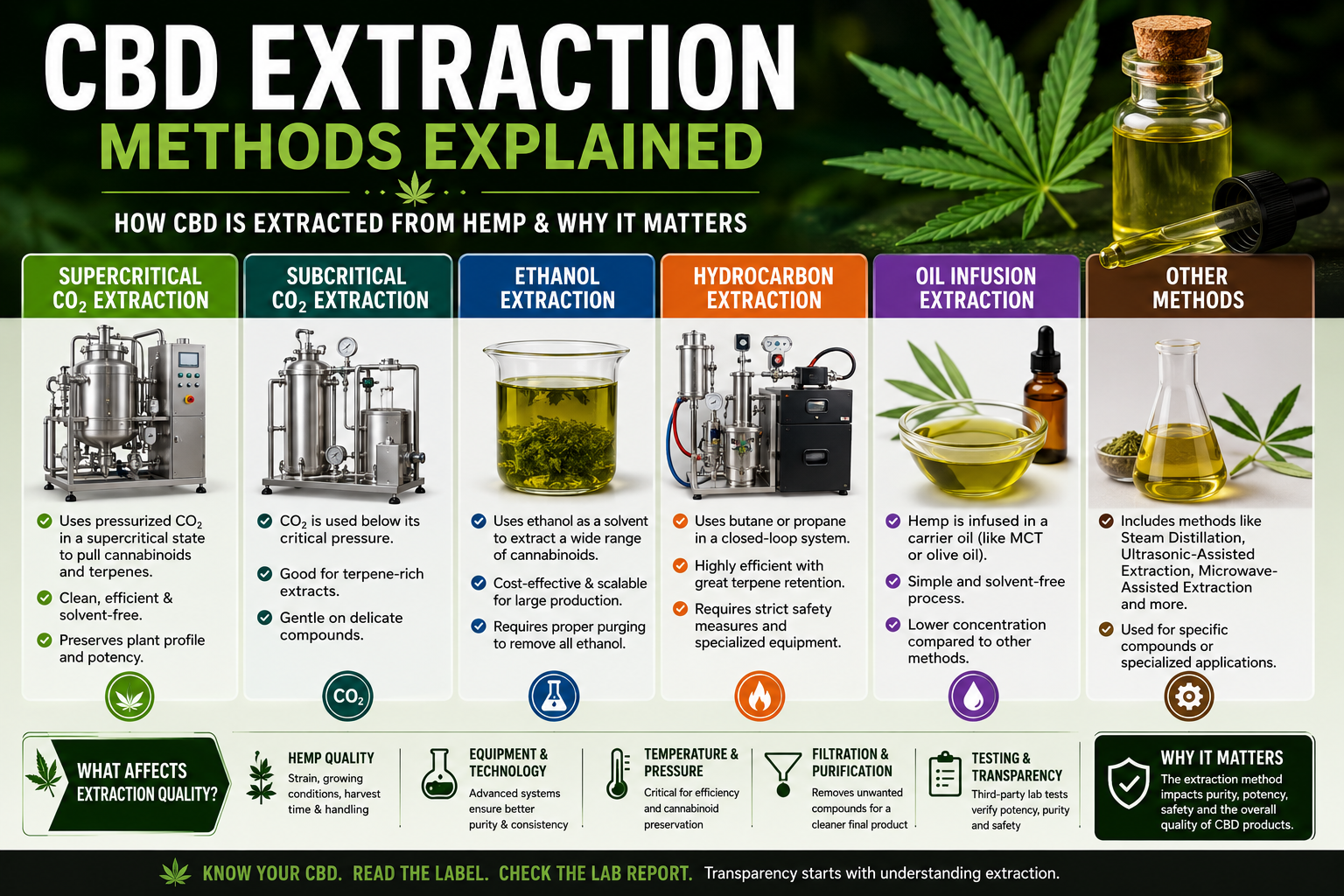
CBD Extraction Methods Explained
CBD Extraction Methods Explained: A Complete Guide to How CBD Is Extracted
CBD Extraction Methods Explained, The quality of a CBD product begins long before it reaches a bottle, capsule, gummy, or other finished formulation. One of the most important stages in production is extraction—the process used to separate desired compounds from hemp plant material. Understanding how extraction works can help consumers better evaluate product labels, manufacturing claims, laboratory reports, and differences between CBD formulations.
In this complete guide to CBD Extraction Methods Explained, we examine the major techniques used in the hemp industry, including supercritical CO2 extraction, subcritical CO2 extraction, ethanol extraction, hydrocarbon extraction, oil infusion, and other emerging technologies. Each method has its own advantages, limitations, equipment requirements, and influence on the resulting extract.
Extraction alone does not determine whether a CBD product is high quality. Hemp source, manufacturing controls, purification, formulation, storage, and third-party laboratory testing also matter. However, the extraction method can significantly influence efficiency, selectivity, production scale, and the composition of the initial extract.
What Is CBD Extraction?
CBD extraction is the process of separating cannabidiol and other selected plant compounds from hemp biomass. Hemp contains a complex mixture of naturally occurring substances, including:
- Cannabinoids
- Terpenes
- Flavonoids
- Waxes
- Lipids
- Chlorophyll
- Plant pigments
- Other botanical compounds
The purpose of extraction is to transfer selected compounds from the solid plant material into an extract that can later undergo additional processing.
Depending on the desired finished product, manufacturers may use further steps such as:
- Filtration
- Winterization
- Solvent recovery
- Decarboxylation
- Distillation
- Chromatography
- Crystallization
- Formulation
This is an important point in CBD Extraction Methods Explained because extraction is rarely the final manufacturing step. The crude extract may require significant refinement before it becomes an ingredient in a finished CBD formulation.
Why CBD Extraction Methods Matter
Different extraction methods can influence:
- Extraction efficiency
- Compound selectivity
- Production cost
- Processing speed
- Equipment requirements
- Scalability
- Solvent recovery needs
- Post-processing requirements
- Final extract composition

For example, one method may extract a broad range of compounds, while another may allow more selective control over certain fractions. Some systems require expensive high-pressure equipment, while others rely on comparatively simpler processing technology.
When comparing methods, it is therefore better to ask:
Which extraction method is appropriate for the intended product and manufacturing system?
rather than assuming that one technique is automatically superior in every situation.
1. Supercritical CO2 Extraction
Supercritical carbon dioxide extraction is one of the best-known methods used in botanical processing.
Carbon dioxide normally exists as a gas under everyday conditions. Under controlled temperature and pressure, however, CO2 can enter a supercritical state. In this state, it displays properties that allow it to move through plant material and dissolve selected compounds.
How Supercritical CO2 Extraction Works
A simplified process generally involves:
- Preparing and loading plant material
- Pressurizing carbon dioxide
- Adjusting temperature and pressure
- Passing supercritical CO2 through the biomass
- Dissolving selected extractable compounds
- Moving the mixture into a separation chamber
- Changing conditions so compounds separate
- Recycling or recovering the CO2
The exact operating parameters depend on the equipment, target compounds, biomass, and manufacturing goals.
Advantages of Supercritical CO2 Extraction
Potential advantages include:
- Adjustable extraction parameters
- Good scalability
- Reduced reliance on certain conventional organic solvents
- CO2 recovery and reuse in suitable systems
- Selective processing opportunities
- Established use in botanical extraction
Limitations of Supercritical CO2 Extraction
Potential limitations include:
- High equipment cost
- Complex machinery
- Skilled operators required
- High-pressure systems
- Maintenance requirements
- Process optimization challenges
A key lesson from CBD Extraction Methods Explained is that the phrase “CO2 extracted” alone does not prove superior quality. Equipment design, operator skill, process validation, raw material quality, and post-processing remain important.
2. Subcritical CO2 Extraction
Subcritical CO2 extraction uses carbon dioxide under conditions different from supercritical processing. The pressure and temperature parameters are generally lower, changing the solvent behavior of CO2.
This can influence which compounds are extracted and how quickly the process operates.
Potential Advantages
Subcritical processing may offer:
- Gentler operating conditions
- Greater selectivity for certain compounds
- Potential preservation of some volatile components
- Controlled fractionation possibilities
Potential Limitations
Possible disadvantages include:
- Slower processing
- Lower throughput
- Reduced extraction efficiency for some target compounds
- Specialized equipment requirements
Subcritical extraction may be useful when a manufacturer prioritizes selectivity rather than maximum throughput.
3. Ethanol Extraction
Ethanol extraction is another widely discussed technique in hemp and botanical processing. Ethanol can dissolve a broad range of plant compounds and can be used in different temperature conditions.
How Ethanol Extraction Works
A simplified process may include:
- Preparing hemp biomass
- Contacting the material with ethanol
- Allowing target compounds to dissolve
- Separating plant solids from the liquid extract
- Filtering the solution
- Recovering ethanol
- Refining the remaining extract
The specific workflow varies significantly between facilities.
Advantages of Ethanol Extraction
Potential benefits include:
- Efficient processing
- Compatibility with large-scale production
- Broad extraction capability
- Established industrial use
- Relatively fast throughput
- Solvent recovery potential
Limitations of Ethanol Extraction
Potential challenges include:
- Co-extraction of chlorophyll and other unwanted compounds
- Need for solvent recovery
- Additional refinement requirements
- Flammability controls
- Strict process management
Temperature can significantly affect extraction behavior. Cold ethanol systems are often discussed because lower temperatures may help reduce extraction of certain unwanted plant components.
4. Hydrocarbon Extraction
Hydrocarbon extraction uses solvents such as butane, propane, or mixtures under controlled industrial conditions.
This approach can be effective for extracting selected botanical compounds, but it requires specialized equipment, engineering controls, solvent management, and rigorous testing.
Potential Advantages
Possible advantages include:
- Efficient extraction
- Selectivity under controlled conditions
- Strong recovery of certain volatile compounds
- Relatively rapid processing
Potential Limitations
Important challenges include:
- Flammability
- Explosion risk
- Strict equipment requirements
- Residual solvent concerns
- Regulatory restrictions
- Need for professional closed-loop systems
Hydrocarbon extraction should not be attempted using improvised equipment. Industrial systems require appropriate engineering, trained personnel, ventilation, monitoring, and compliance controls.
5. Oil Infusion Extraction
Oil infusion is one of the simpler concepts discussed in CBD Extraction Methods Explained.
In this approach, plant material is combined with a carrier oil so selected oil-soluble compounds transfer into the oil.
Possible carrier oils may include:
- MCT oil
- Olive oil
- Coconut-derived oils
- Other food-compatible oils
Advantages of Oil Infusion
Potential benefits include:
- Relatively simple concept
- No high-pressure machinery
- Direct compatibility with some oil-based formulations
- Reduced need for complex solvent recovery
Limitations of Oil Infusion
Possible disadvantages include:
- Lower concentration potential
- Limited scalability
- Shorter stability depending on formulation
- Less efficient separation
- Carrier oil remains part of the final mixture
Oil infusion is generally different from industrial extraction methods designed to create highly concentrated extracts.
6. Steam Distillation
Steam distillation is widely associated with essential oil production and volatile aromatic compounds.
During the process:
- Steam passes through plant material
- Volatile compounds vaporize
- Vapors travel into a condenser
- Cooling converts vapor back into liquid
- Fractions are separated
For CBD production, steam distillation is generally less central than CO2 or ethanol extraction because cannabinoids are not handled in the same way as highly volatile essential-oil components.
However, steam-based methods may be relevant to aromatic fractions and terpene-related processing.
7. Ultrasonic-Assisted Extraction
Ultrasonic-assisted extraction uses sound-wave energy to improve contact between plant material and a solvent system.
The process can create physical effects that help disrupt plant structures and improve mass transfer.
Potential Advantages
- Faster extraction
- Improved solvent penetration
- Reduced processing time
- Potential efficiency improvements
Potential Limitations
- Equipment requirements
- Scale-up challenges
- Temperature control
- Process optimization needs
This method is an example of how extraction technology continues to evolve.
8. Microwave-Assisted Extraction
Microwave-assisted extraction uses controlled microwave energy to heat materials and improve the movement of target compounds into an extraction medium.
Potential advantages may include:
- Faster processing
- Reduced extraction time
- Improved efficiency
- Lower solvent requirements in some systems
Potential limitations include:
- Specialized equipment
- Heat management
- Scale-up complexity
- Risk of degrading heat-sensitive compounds if poorly controlled
The effectiveness of the method depends heavily on process design.
9. Pressurized Liquid Extraction
Pressurized liquid extraction uses solvents at elevated temperature and pressure while maintaining the solvent in a liquid state.
This can improve:
- Solvent penetration
- Mass transfer
- Extraction speed
- Recovery efficiency
However, the method requires specialized equipment and carefully controlled conditions.
10. Lipid-Based Extraction
Lipid-based extraction uses fats or oils to dissolve oil-soluble plant compounds.
This category overlaps conceptually with oil infusion but may involve more controlled manufacturing systems.
The method may be attractive for formulations intended to remain oil-based, but concentration and purification options can be more limited than with methods that create a separable crude extract.
Supercritical CO2 vs Ethanol Extraction
A common question in CBD Extraction Methods Explained is whether CO2 or ethanol extraction is better.
The answer depends on manufacturing priorities.
CO2 Extraction
Often associated with:
- Adjustable selectivity
- High-pressure equipment
- Significant initial investment
- Controlled fractionation
- CO2 recycling
Ethanol Extraction
Often associated with:
- High throughput
- Broad extraction capability
- Large-scale processing
- Solvent recovery systems
- Potential co-extraction of unwanted compounds
Neither method automatically guarantees a superior finished product.
A poorly controlled CO2 process can produce an undesirable extract, while a carefully optimized ethanol process can produce a highly refined ingredient. The reverse can also be true.
What Is Winterization?
Winterization is a post-extraction refinement step used to remove certain waxes, fats, and lipids.
A simplified process may involve:
- Dissolving extract in a suitable solvent
- Cooling the solution
- Allowing waxes and lipids to precipitate
- Filtering the mixture
- Recovering the solvent
Winterization can improve the clarity and composition of an extract before additional refinement.
It is important not to confuse winterization with extraction itself.
What Is Decarboxylation?
Fresh or minimally processed hemp may contain acidic cannabinoid forms such as CBDA.
Decarboxylation uses controlled heat to convert certain acidic cannabinoids into their neutral forms.
For example:
CBDA → CBD
The transformation involves the removal of a carboxyl group and release of carbon dioxide.
Temperature and time must be controlled because excessive heat can contribute to unwanted degradation.
What Is CBD Distillation?
Distillation is a refinement process that may be used after extraction.
It separates compounds based on differences in volatility under controlled temperature and pressure conditions.
CBD distillate is typically more refined than crude extract and may contain a concentrated cannabinoid fraction.
Distillation does not necessarily produce pure CBD isolate.
What Is CBD Isolate Production?
CBD isolate is a highly purified form of cannabidiol.
Production may involve multiple stages, potentially including:
- Extraction
- Filtration
- Winterization
- Decarboxylation
- Distillation
- Chromatographic separation
- Crystallization
The exact manufacturing process varies.
This demonstrates why CBD Extraction Methods Explained should not treat extraction and purification as identical concepts.
How Extraction Can Affect the Final CBD Product
Extraction methods may influence:
Cannabinoid Composition
Different conditions may extract compounds with different efficiencies.
Terpene Retention
Some volatile compounds are sensitive to heat and processing conditions.
Chlorophyll Content
Broad extraction methods may pull chlorophyll from plant material, affecting color and taste.
Wax and Lipid Content
Some processes extract significant plant waxes and fats that may require later removal.
Post-Processing Requirements
A crude extract may need substantial refinement before formulation.
How to Evaluate CBD Extraction Claims
Consumers frequently encounter marketing phrases such as:
- CO2 extracted
- Clean extraction
- Premium extraction
- Solvent-free
- Advanced extraction technology
These claims should be evaluated critically.
Useful questions include:
- Is the extraction method clearly identified?
- Does the manufacturer explain post-processing?
- Are batch-specific laboratory reports available?
- Was residual solvent testing performed where relevant?
- Is cannabinoid potency verified?
- Are contaminant panels available?
- Does the Certificate of Analysis match the product batch?
A strong extraction claim should be supported by broader manufacturing transparency.
Does Extraction Method Determine CBD Quality?
No. Extraction is only one part of product quality.
Other important factors include:
- Hemp source
- Agricultural practices
- Harvesting
- Drying
- Storage
- Extraction controls
- Refinement
- Formulation
- Packaging
- Laboratory testing
- Stability
- Traceability
A sophisticated extraction system cannot compensate for contaminated raw material or poor manufacturing controls.
Likewise, a simpler method does not automatically mean the finished product is low quality.
Frequently Asked Questions
What is the most common CBD extraction method?
CO2 and ethanol extraction are among the most widely discussed methods in commercial hemp processing. Actual use varies by manufacturer, facility, scale, and product type.
Is CO2 extraction always better?
No. CO2 extraction offers important advantages, but product quality depends on process control, equipment, raw materials, refinement, and testing.
What is ethanol extraction?
Ethanol extraction uses ethanol as a solvent to dissolve selected compounds from plant material before filtration, solvent recovery, and further refinement.
Can extraction affect CBD color?
Yes. Extract color may be influenced by chlorophyll, pigments, oxidation, refinement, raw material, and processing conditions.
What is the difference between extraction and distillation?
Extraction separates compounds from plant material. Distillation is a later refinement process used to separate components based on physical properties under controlled conditions.
Why is residual solvent testing important?
When solvents are used during processing, residual solvent analysis can help determine whether specified solvent residues remain at measurable concentrations in the tested sample.
Does a COA show the extraction method?
Sometimes, but not always. A Certificate of Analysis primarily reports laboratory findings. Extraction information may instead appear in technical documentation or manufacturer disclosures.
Final Thoughts
Understanding CBD Extraction Methods Explained provides valuable insight into how CBD ingredients move from hemp biomass to refined formulations. Major methods include supercritical CO2 extraction, subcritical CO2 extraction, ethanol extraction, hydrocarbon extraction, oil infusion, and several emerging technologies such as ultrasonic-assisted and microwave-assisted extraction.
Each method has advantages and limitations. CO2 offers adjustable processing conditions but requires expensive high-pressure equipment. Ethanol can support efficient large-scale production but may require significant solvent recovery and refinement. Oil infusion is simpler but has concentration and scalability limitations. Hydrocarbon systems can be efficient but demand strict professional safety controls.
The most important conclusion is that extraction method alone does not determine CBD product quality. A reliable evaluation should also consider hemp source, manufacturing controls, post-processing, formulation, batch traceability, storage, and independent laboratory testing.
By understanding extraction terminology and comparing manufacturing claims with verifiable documentation, consumers can evaluate CBD products more critically and make better-informed decisions based on transparency rather than marketing language alone.