
No products in the cart.
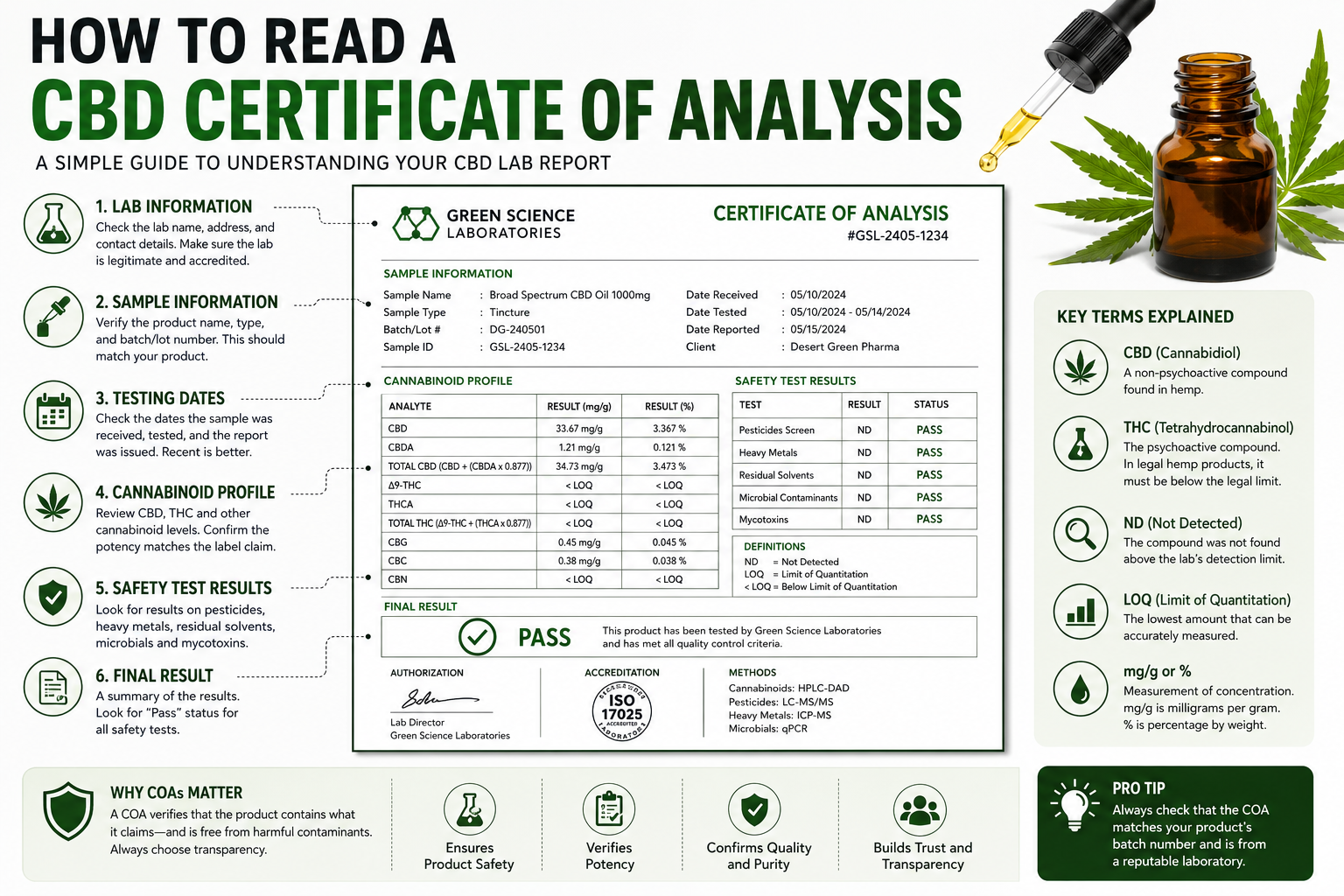
How to Read a CBD Certificate of Analysis
How to Read a CBD Certificate of Analysis: A Complete Guide
As the CBD market continues to grow, understanding product quality, transparency, and laboratory testing has become increasingly important. A product label may provide useful information about CBD strength and ingredients, but independent laboratory results can offer a much deeper look at what a tested sample actually contains. This is why learning how to read a CBD Certificate of Analysis is an essential skill for consumers who want to evaluate CBD products more carefully.
A Certificate of Analysis, commonly called a COA, is a laboratory report that presents test results for a specific product or sample. Depending on the laboratory and the scope of testing, the document may show cannabinoid concentrations, THC results, terpene profiles, pesticides, heavy metals, residual solvents, microbial contaminants, and other quality-related measurements.
However, laboratory reports can appear confusing at first. Terms such as LOQ, LOD, ND, mg/g, mg/mL, batch number, and cannabinoid profile may not be immediately clear to a beginner. This guide explains how to read a CBD Certificate of Analysis step by step, what information deserves attention, and which warning signs may suggest that further verification is needed.
What Is a CBD Certificate of Analysis?
A CBD Certificate of Analysis is a document that reports laboratory test results for a CBD-containing sample. It is usually produced after a laboratory analyzes the product using validated analytical methods appropriate to the substances being measured.
The exact format varies between laboratories, but a typical COA may include:
- Laboratory name and contact information
- Report or certificate number
- Sample identification
- Product name
- Batch or lot number
- Date received
- Date tested
- Date reported
- Cannabinoid profile
- CBD concentration
- THC concentration
- Contaminant screening
- Testing methods
- Detection limits
- Pass or fail results
- Laboratory authorization or signature
A COA should be treated as a technical document rather than a marketing brochure. Its purpose is to report analytical findings for the sample tested.
Why Learning How to Read a CBD Certificate of Analysis Matters
Learning how to read a CBD Certificate of Analysis helps consumers move beyond packaging claims. A label might say “high strength,” “THC-free,” “premium,” or “lab tested,” but those phrases alone do not explain what was measured, which batch was tested, or whether contaminant screening was performed.
A careful COA review can help answer questions such as:
- Does the tested sample contain the stated cannabinoid?
- Is the measured CBD concentration reasonably consistent with the label?
- Was THC detected?
- Were pesticides included in the testing scope?
- Were heavy metals analyzed?
- Was microbial screening performed?
- Does the batch number match the product?
- Is the report recent enough to be relevant?
- Can the laboratory be independently identified?
The goal is not simply to find the word “pass.” The goal is to understand what was actually tested.
1. Start by Checking the Laboratory Information
The first step in understanding how to read a CBD Certificate of Analysis is identifying the laboratory responsible for the report.
Look for:
- Full laboratory name
- Physical or registered address
- Contact information
- Website details
- Accreditation information where applicable
- Report identification number
- Authorized signature or approval
A report with no identifiable laboratory information deserves additional scrutiny. A professional-looking PDF is not automatically proof that independent testing occurred.
Where accreditation is claimed, verify the claim through an appropriate accreditation body or official directory rather than relying only on a logo displayed on the document.
2. Check the Product Name and Sample Identity
Next, confirm exactly what sample the COA describes.
Look for fields such as:
- Sample name
- Product name
- Product type
- Sample ID
- Client ID
- Laboratory ID

For example, a report might identify a sample as:
“Broad Spectrum CBD Oil 1000 mg – 30 mL”
That is much more useful than a vague description such as:
“CBD Sample”
The clearer the sample identification, the easier it is to connect the report to the product being evaluated.
3. Match the Batch or Lot Number
One of the most important parts of learning how to read a CBD Certificate of Analysis is checking the batch or lot number.
CBD products are manufactured in batches. Different batches may vary because of:
- Raw material differences
- Ingredient variation
- Manufacturing conditions
- Storage conditions
- Formulation adjustments
- Processing differences
If the bottle shows:
Batch: DG-260701
the COA should ideally reference the same batch or lot identifier.
A COA for an unrelated batch may provide general background about a product line, but it does not directly establish the analytical results of the batch in your possession.
4. Check the Testing Dates
A COA should normally include relevant dates, such as:
- Sample received date
- Testing date
- Analysis date
- Report issue date
Dates help establish context.
If a product was manufactured recently but the available laboratory report is several years old, ask whether the COA actually corresponds to the current batch.
Testing dates are especially important when evaluating products whose composition may be affected by:
- Heat
- Light
- Oxygen
- Long storage periods
- Packaging conditions
Recent does not automatically mean reliable, and old does not automatically mean invalid. The key question is whether the report is relevant to the specific batch.
5. Understand the Cannabinoid Profile
The cannabinoid profile is often one of the most closely examined sections of a CBD COA.
Depending on the product and laboratory panel, the report may include:
- CBD
- CBDA
- THC
- THCA
- CBG
- CBGA
- CBC
- CBN
- Other measured cannabinoids
The laboratory may report these compounds using units such as:
- %
- mg/g
- mg/mL
- mg per unit
Understanding the units is essential because the same numerical value can mean very different things depending on the measurement system.
6. Find the CBD Result
When learning how to read a CBD Certificate of Analysis, locate the CBD result and determine how it is expressed.
Suppose a product claims:
1000 mg CBD in a 30 mL bottle
The COA may report CBD as:
- mg/mL
- mg/g
- percentage by weight
- total CBD
If CBD is reported as 33 mg/mL, a rough calculation across 30 mL would be:
33 × 30 = 990 mg
That result is relatively close to a 1000 mg label claim.
However, calculations should be made carefully because density, reporting conventions, uncertainty, sample preparation, and laboratory methodology can affect interpretation. Do not automatically compare unlike units.
7. Understand Total CBD
Some laboratory reports distinguish between CBD and CBDA.
CBD and CBDA are related but chemically distinct compounds. Depending on the product type and analytical approach, a report may calculate “Total CBD” using a formula that accounts for potential conversion from CBDA.
A commonly used conceptual calculation is:
Total CBD = CBD + (CBDA × conversion factor)
The exact presentation should be explained by the laboratory.
This matters because the number shown as “CBD” may not always be identical to the number shown as “Total CBD.”
8. Review the THC Results Carefully
Another essential part of understanding how to read a CBD Certificate of Analysis is reviewing THC-related results.
Depending on the testing panel, you may see:
- Delta-9 THC
- THCA
- Total THC
- Other THC-related analytes
Possible result terms include:
- ND
- Not Detected
- <LOD
- <LOQ
- Numeric concentration
These terms are not interchangeable.
A “THC-free” marketing claim should be evaluated against:
- The specific THC analytes tested
- The laboratory’s detection capability
- The reporting limits
- The applicable legal definition in the relevant jurisdiction
CBD and THC rules differ significantly between countries. Consumers should verify current local laws rather than assuming that a threshold used in one market applies everywhere.
9. Understand ND, LOD, and LOQ
These abbreviations are extremely important.
ND — Not Detected
ND usually means the substance was not detected according to the laboratory’s method and reporting criteria.
It does not necessarily prove absolute zero molecules of the substance exist.
LOD — Limit of Detection
The LOD is generally the lowest concentration at which an analytical method can detect that an analyte appears to be present.
LOQ — Limit of Quantitation
The LOQ is generally the lowest concentration at which the analyte can be quantified with acceptable performance under the method.
Therefore:
- ND does not always mean absolute zero
- Below LOD means the method did not reliably detect the substance
- Below LOQ may mean a substance is present but cannot be reliably quantified at that level
Understanding these distinctions is central to learning how to read a CBD Certificate of Analysis correctly.
10. Check the Pesticide Screening
A comprehensive quality-focused COA may include pesticide analysis.
The report may list numerous individual compounds with results such as:
- Pass
- ND
- Below reporting limit
- Numeric result
Do not assume that “lab tested” automatically means pesticide tested.
A product may have undergone cannabinoid potency testing only.
Check whether the report actually contains a pesticide panel.
Questions to ask include:
- Which pesticides were tested?
- How many analytes were included?
- What limits were applied?
- Were all tested compounds within the stated criteria?
11. Review Heavy Metal Testing
Heavy metals can be relevant to botanical products because plants may accumulate elements from soil and the surrounding environment.
A heavy metal panel may include:
- Lead
- Cadmium
- Arsenic
- Mercury
The report may show:
- Measured concentration
- Reporting limit
- Action limit
- Pass/fail status
A “pass” result should be interpreted in relation to the standard or threshold applied by the laboratory or relevant regulatory framework.
12. Check Residual Solvent Results
Some extraction and manufacturing processes may involve solvents. Residual solvent testing evaluates whether specified solvents remain in the tested sample at measurable levels.
A report may include compounds such as:
- Ethanol
- Butane
- Propane
- Hexane
- Heptane
- Acetone
- Other process-related solvents
The exact panel depends on the product and laboratory.
When reviewing this section, look for:
- Individual solvent names
- Measured results
- Reporting limits
- Applicable thresholds
- Pass/fail status
13. Review Microbial Testing
Microbial screening may evaluate potential contamination from microorganisms.
Depending on the laboratory and product type, testing may include:
- Total aerobic microbial count
- Yeast
- Mold
- E. coli
- Salmonella
- Other specified organisms
This section is especially important because a cannabinoid potency result alone says nothing about microbial quality.
A product can match its CBD label and still lack broader contaminant screening.
14. Look for Mycotoxin Testing
Mycotoxins are toxic compounds produced by certain molds.
Some laboratory panels may test for:
- Aflatoxins
- Ochratoxin A
If a brand claims comprehensive safety testing, check whether mycotoxin screening is actually included rather than assuming it is covered by a general “lab tested” statement.
15. Understand Pass and Fail Results
Many COAs simplify results using:
- PASS
- FAIL
This can be helpful, but consumers should still investigate:
- What standard was applied?
- Which jurisdiction was referenced?
- What action limit was used?
- Was every relevant analyte tested?
A pass result only applies to the test and acceptance criteria shown.
It does not mean that every possible contaminant was analyzed.
16. Check the Testing Method
Advanced COAs may identify analytical techniques or method references.
Examples may include:
- HPLC
- LC-MS
- GC-MS
- ICP-MS
Different techniques are used for different analytical purposes.
For example:
- HPLC may be used for cannabinoid analysis
- ICP-MS may be used for elemental or heavy metal analysis
- GC-MS may be used for certain volatile compounds or residual solvents
Consumers do not need to become laboratory scientists, but the presence of clear method information can improve transparency.
17. Check Whether the COA Is Complete
A common mistake is assuming that every COA includes comprehensive testing.
Some reports contain only:
- CBD
- THC
- Cannabinoid potency
Others may include:
- Cannabinoids
- Pesticides
- Heavy metals
- Residual solvents
- Microbial contaminants
- Mycotoxins
Therefore, when learning how to read a CBD Certificate of Analysis, always ask:
What was not tested?
The absence of a contaminant section is not the same as a passing contaminant result.
Common CBD COA Red Flags
Several warning signs deserve closer attention:
- No laboratory name
- No report number
- No sample ID
- Missing batch number
- Product batch does not match the report
- Extremely old testing date
- Blurry screenshots instead of complete reports
- Missing pages
- No measurement units
- No analytical methods
- Unclear pass/fail criteria
- Only potency testing despite broad safety claims
- Edited-looking documents
- Broken QR codes
- A single generic COA used for every product
- Laboratory claims that cannot be independently verified
One red flag does not automatically prove a product is poor quality, but multiple inconsistencies justify further investigation.
Quick CBD COA Checklist
Before relying on a report, check the following:
- Is the laboratory clearly identified?
- Is there a unique report number?
- Does the product name match?
- Does the batch number match?
- Are testing dates visible?
- Is CBD concentration reported?
- Are THC results shown?
- Are measurement units clear?
- Are LOD and LOQ explained?
- Was pesticide testing performed?
- Was heavy metal testing performed?
- Were residual solvents tested?
- Was microbial testing performed?
- Is the complete report available?
- Can the report be independently verified?
Frequently Asked Questions
What does COA mean in CBD?
COA means Certificate of Analysis. It is a laboratory report presenting analytical results for a tested sample.
Does a COA prove a CBD product is safe?
Not automatically. A COA reports the tests that were performed. If only cannabinoid potency was tested, the report does not establish results for pesticides, heavy metals, microbes, or other untested contaminants.
What does ND mean on a CBD COA?
ND generally means “Not Detected” according to the laboratory’s method and reporting criteria. It should not automatically be interpreted as absolute zero.
What is the difference between LOD and LOQ?
LOD refers to the limit of detection, while LOQ refers to the limit of quantitation. The exact technical definitions depend on the method and laboratory.
Should the batch number match the CBD product?
Ideally, yes. A matching batch or lot number helps connect the laboratory report to the specific production batch being evaluated.
How often should CBD products be tested?
Testing frequency depends on manufacturing systems, quality procedures, product type, regulatory requirements, and batch controls. Batch-specific testing provides stronger traceability than relying indefinitely on one generic report.
Can a QR code link to a COA?
Yes. Some products use QR codes to provide access to laboratory reports. However, consumers should still check whether the linked COA matches the product and batch.
Final Thoughts
Understanding how to read a CBD Certificate of Analysis can make product evaluation more evidence-based and less dependent on marketing language. A strong review begins with laboratory identity, sample information, batch matching, and testing dates before moving into cannabinoid concentrations and contaminant panels.
The most important principle is simple: do not look only for the word “pass.” Check what was tested, how results were reported, whether the units make sense, whether the batch matches, and whether important testing categories are missing.
Once you understand how to read a CBD Certificate of Analysis, technical terms such as ND, LOD, LOQ, mg/mL, cannabinoid profile, residual solvents, and microbial screening become easier to interpret. That knowledge can help consumers compare CBD products more critically and recognize the difference between a meaningful laboratory report and a vague “lab tested” claim.
For the strongest evaluation, combine COA review with transparent ingredient information, accurate labeling, appropriate storage guidance, verifiable manufacturer details, and awareness of current laws in the relevant jurisdiction.